


Case Study: Chappell Roan's Trust Issue
- Dr. Louise Pay | MCIPR

- May 2
- 10 min read
When A Pattern Shapes The Narrative
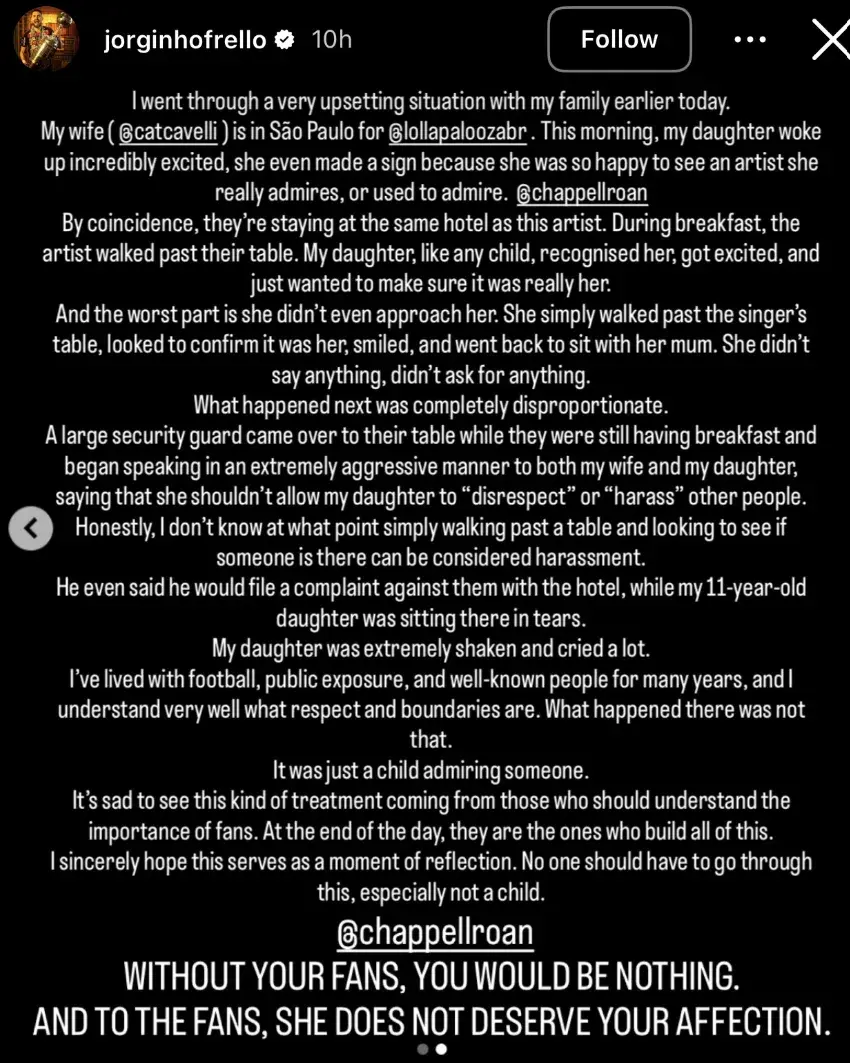
Chappell Roan recently faced backlash over a misunderstanding. Brazilian footballer Jorginho Frello posted an Instagram story about a negative encounter his stepdaughter (Jude Law’s daughter) had with security in a hotel they and Roan were both staying in, attributing the issue to Roan’s security:
Chappell Roan eventually posted a video response:
[Transcript]: “I’m just going to tell my half of the story of what happened today with a mother and child who were involved with a security guard who is not my personal security. I didn’t even see… I didn’t even see a woman and a child. Like I did not… No one came up to me. No one bothered me. Like I was just sitting at breakfast in my hotel. I think these people were staying at the hotel as well. So, the fact that, like a security guard, who was… I did NOT ask the security guard to go up and talk to this mother and child. I did not… They did not come up to me. They weren’t doing anything. It’s unfair for security to just assume someone doesn’t have good intentions when they have no reason to believe… because there’s no action even taken. Like, I do not hate people who are fans of my music. I do not hate children. Like that is crazy. I am sorry to the mother and child that someone was assuming something, that you would do something, and that… if you felt uncomfortable, that makes me really sad. You did not deserve that.”
Before that video was released, another screenshot of a supposed response from Roan was circulating online:

This screenshotted ‘response’ is fake.
It still showed up in the comments section under videos about Roan after this incident, with people thinking it was real.
Why did people believe this fake response was real?
There is a reason that screenshot wasn’t immediately dismissed as fake, even though it was easy to confirm that it wasn’t real.
Roan draws a strong boundary between her public and private identity, with ‘Chappell Roan’ being what she describes as a drag persona. Her legal name is Kayleigh Rose Amstutz. She sees Chappell Roan as a character she plays at work. The expectation that she must be ‘on’ at all times (like at breakfast in a hotel) is, in her view, a misunderstanding of the relationship between her and her audience: they’re buying music and tickets to a show, not access to Kayleigh Amstutz. This framing is an interesting contrast to traditional celebrity culture, and it has created some backlash.
Roan has posted emotional videos to social media telling fans not to approach her when she’s not working, describing “predatory behavior” from fans and the media. She has become known for directness and a refusal to soften her messaging with gratitude or apology. Some see her as a celebrity complaining about the inconveniences of fame; others, a woman describing a pattern of behavior that caused her genuine psychological trauma.
Roan’s encounters with photographers have resulted in some extremely viral moments, such as at the 2024 MTV Video Music Awards, where a photographer yelled at her to “Shut the fuck up,” and she responded, “You shut the fuck up. Not me, bitch.” Later, she recognized a photographer she had encountered previously and addressed him directly:
You were so disrespectful to me at the Grammys. You yelled at me at a Grammy party. And I deserve an apology for that.
Most recently, in March 2026, during Paris Fashion Week, Roan was surrounded by photographers and fans while on her way to dinner and, after repeatedly asking them to leave, began filming the crowd:
I’m just trying to go to dinner, and I’ve asked these people several times to get away from me… All of you, I’m asking you kindly to please leave me alone and stop following me and harassing me. No, I’m not gonna sign. This is what it’s like, if you were wondering how it is.
Many view these incidents as defiance against the way photographers treat celebrities, particularly women; critics argue that Roan is either a diva or isn’t suited to the demands of public life… and blames the public for it, seeking attention while simultaneously complaining about it.
The most common counterargument to Roan’s position is that celebrities, by choosing public life and benefiting financially from public attention, implicitly accept a degree of intrusion. Roan rejects this.
Other celebrities have supported her. For example, Hayley Williams (Paramore) wrote: “wrote that “this happens to every woman I know from this business, myself included. Social media has made this worse. I’m really thankful Chappell is willing to address it in a real way, in real time. It’s brave and unfortunately necessary.”
But Roan has received sustained backlash, being accused of ingratitude, being ‘fake’, and not boundary-setting, but being actively hostile to fans. Roan acknowledged this herself in a 2025 Call Her Daddy podcast:
I think people are scared of me. I think I made a big enough deal about not talking to me that people do not talk to me. I think that’s the truth of it all.
Roan’s position is understandable. She wants the transaction to be between the audience and the art, not the audience and the person. But that distance from her audience that she seeks and the way she publicly discusses her position creates a perception that makes the fake response screenshotted above extremely believable.
Simply put, people believe that Chappell Roan is the type of person who would call security on a child walking past her table and blame them for ruining her breakfast.
Chappell’s public persona is defined enough by hostility to intrusion that this fabricated response is credible.
This is Chappell Roan’s trust problem.
When Roan did post her actual response, one relying heavily on distancing herself from the situation, many commenters dissected her body language, dilated pupils, and tone, with some dismissing it as damage control and others outright saying they thought she was lying.
The massive distance Roan creates between herself and her audience means that that audience will fill that space with a caricature based on the most visible data points available. If those data points are you yelling at paparazzi and complaining about fans on TikTok, that’s going to be ‘The Pop Star Who Hates Being Approached,’ and any narrative aligning with that will be quite easily interpreted as fact.
The reality of the music industry is that the transaction is never just about the art. Fans invest emotionally in the artist, and in return, the artist performs a kind of stylized gratitude. Roan doesn’t perform that gratitude, and, regardless of how valid her reasons are, this breaks the social contract and makes it harder for many people to have empathy for her. When you tell the public that you owe them nothing, repeatedly and forcefully, the public will eventually decide that they owe you no benefit of the doubt.
So many didn’t wait for the facts before judging Roan in this breakfast hotel situation. They looked at the caricature of Chappell Roan they had built in their minds from the pattern of behavior they'd noticed reported in the media and shared across social media. They looked at the fake screenshot that aligned with this narrative, then watched her distance herself from the situation in a much softer tone than she usually presents… and decided she was guilty
What We Can Learn From This
When a reputational issue develops over time through multiple reported events, it forms an overall narrative that shapes how you are perceived as a person. Regardless of the context surrounding why you have acted a certain way in previous situations, and the extent to which the media and social media pull short clips of interactions and present them as additions to the narrative without the rest of the interaction, these multiple events shape what people expect from you.
So, when new information emerges that is consistent with that narrative, the response is often a discussion of how you act, i.e., who you are as a person, rather than a debate around what actually happened in that specific instance.
This is essentially the fundamental attribution error, where we attribute behavior to who a person is rather than the circumstance they're in when we're observing others (interestingly, we don't do this to ourselves: if we kick a table in annoyance, it's because of the thing that's annoyed us, not because we're an angry person; if we watch someone else kick a table, we tend to think they did it because they're an angry person).
Reputational issues that build over time through multiple instances that aren't necessarily scandals in their own right are particularly difficult to counter because it's harder to argue that they have all been taken out of context or that none of them truly reflect your character. If you get a reputation for being difficult to work with due to several instances of 'difficult' behavior, whether fair or accurate, that reputation 'sticks' and works against you a little more each time it happens because people notice patterns and they construct their idea of reality around them.
The more evidence there is, the stronger their opinion will be. And most people aren't really analyzing your behavior and considering the circumstances and external factors involved. They're just responding to what they've seen in short media clips and social discussion and forming a picture of you from those, almost subconsciously, because video clips and descriptions of encounters with you sound like fact and they're memorable. The negative associations are memorable. And because they've formed this opinion, they'll look at your future interactions through that lens and expect the negative behavior.
When we expect negative behavior from someone, we might read negativity in a situation where there was none. If you think your boss is an asshole, you might interpret his 'resting bitch face' at the start of a meeting as negative feelings toward you when he's just thinking about what he's having for lunch. If you think your mother is judgmental, you might take her directness about the color of your new coat as judgment of you rather than an indicator that she simply doesn't like the shade.
At this point, the facts of new scenarios start to matter less, because the audience is already primed to expect (and see) negative behavior. So in a situation like Chappell Roan's with that security guard, many people weren't even questioning whether or not the situation was as Jorginho presented it (it turns out it wasn't, and this was cleared up later). The initial public reaction here shows the extent to which past perception shapes a narrative in a new situation. This security guard encounter fit very well into the narrative many already had about Roan. If the initial story was about, for example, Taylor Swift or Miley Cyrus, who (at least at the time I wrote this, you never know when things like this can change...) have reputations for positive interactions with their fans, the reaction would likely have been more focused on the what regarding what happened and where the truth was in the story, rather than on the character of the celebrity involved.
You don't want to be in a situation where you can be clipped in a 5-second video saying or doing something negative and your audience thinks, "Yeah, that tracks."
Changing The Narrative
When the narrative surrounding us is associated with negative behavior (like rudeness to fans and the media, in Roan’s case), it makes sense to want to demonstrate the opposite as a counter to that narrative; however, this can be a mistake. If you are perceived a certain way because of how your reputation has been shaped by multiple events over time, your audience knows you know. And when you start presenting the inverse of that narrative, the audience becomes more analytical and wants to know what lies behind that ‘new’ behavior. A change that appears too sudden, convenient, or directly aligned with the criticism can become part of the problem, because rather than being interpreted as a genuine reflection of your character, it may be seen as evidence that you and your team are trying to manage your reputation. In other words, it’s seen as inauthentic.
Once audiences decide an interaction is being performed for reputational reasons, it loses much of its value. A kind gesture can soften perception if it’s spontaneous (or, at least, perceived to be). Unfortunately, that fundamental attribution error I mentioned above doesn’t apply very well to positive situations. People are much more likely to think you’re exhibiting positive behavior that counters previous negative ones because of the circumstances (i.e., a need to correct the narrative) rather than because of who you are as a person. This is one reason it is difficult to correct well-established reputational issues that are related to how people see you, rather than how they see your reactions.
Reputation repair isn’t supposed to be a visible process. It’s supposed to gradually shift how people perceive us, not tell people how we want them to see us and expect them to change their opinion because of that. We don’t want people looking at our behavior and thinking, “She’s trying to change the narrative”.
Directly addressing it just reinforces that there is a narrative that we want to change. And that tends to make the audience focus even more on the negative. Essentially, we confirm that the negative behavior is true because we’re trying so obviously to get people to believe the opposite. It bothers us enough that we have to correct it.
Direct correction like this can also lead to us over-correcting it in a way that sets another precedent we don’t even want, something we don’t align with. In Roan’s case, this matters because directness and strong boundaries are clearly part of her persona that she wants to keep.
So, what can we do?
Take Your Time
Time is the most important factor. Correcting a narrative formed through a repeated pattern of interactions over time requires substantial time, creating enough varied, credible evidence that makes the previous negative narrative appear factually inconsistent with who you are as a person in the long term. So, instead of directly addressing and countering accusations, focus on the future and, generally, consistently and believably show up in a way you want to be perceived. That's how you’re going to gradually shift that narrative. It is not an ‘overnight fix’; that’s not possible here.
Reduce Risk
Avoid engaging in high-friction interactions that are easy to clip and circulate without the surrounding context. Engage in interactions that allow you to show who you are and what you stand for naturally and without mentioning the situations and narrative you’re trying to counter. Don’t tie back new positive interactions and discussions to past events.
Contextualize
Reframe the characteristics that have resulted in the negative perception in new contexts. If part of the criticism is related to traits that you have and express naturally, like Roan’s boundary-setting, you don’t want to eliminate those and pretend they don’t exist because, well, they do exist. Instead, show and explain them in different contexts so that people understand where they come from and how they fit in with your character overall, rather than being a defining, negative characteristic that’s only acknowledged in sensationalized clips. This helps to complete the narrative around you and explains why you present in a certain way, so your audience has a less narrow view of specific behaviors.
Summary

You need a gradual accumulation of different contexts, interaction types, and evidence that are not shaped by the same pressure and tension as the original moments and are not perceptively intended to prove something, so over time, that broader evidence base begins to replace the original narrative (emphasis on over time; don’t get impatient here!).
These all have to be believable and consistent with your overall presentation and explain the context behind how you show up in the world. Make those negative traits coherent with your overall narrative. A person can be direct without being cruel, boundaried without being dismissive, and private without being arrogant. That is the distinction the public needs help making.
Comments